
Pregnancy is broken down into weeks, and is divided into three equal parts called trimesters. Full term pregnancy is considered 40 weeks and an infant delivered before the 37th week completed is considered premature. Premature infants may have problems with their growth and development, as well as difficulties in breathing and digesting. Pregnancy is counted from the first day of a your last period. This means that at conception, the unborn baby is already considered two weeks old. Also see BabiesDirect month to month diary to learn about the emotional and physical journey of pregnancy.
Fetal Development
2 weeks – The sperm and egg join in the fallopian tube and fertilization has occurred. The baby begins to form from a single fertilized egg to a cell that has divided itself and is  now multiplying rapidly. Forty-six chromosomes combine, which pre-determine all of a person’s physical characteristics. Thirty hours later the developing embryo is still rapidly dividing and it floats down from the fallopian tube and towards the uterus. If the embryo doesn’t get to the uterus and stays is the fallopian tube, the result is Ectopic pregnancy. Make sure you refer to our nutrition section as it is VERY important.
3 weeks – Now the when the developing embryo is in the uterus, it searches for a nice place to implant. When one is found the embryo burrows beneath the surface of the uterus. During these early weeks of life blood cells are being produces by the yolk sac. The unborn baby is only one-sixth of an inch long, but is rapidly developing. The backbone, spinal column, and nervous system are forming. The kidneys, liver, and intestines are taking shape.
What Tests will Doctors Run
at this point in my Pregnancy?
4 weeks – At week four, you might begin to suspect you’re pregnant since the embryo produces hormones which stop the mother’s menstrual cycle. The fertilized egg, now called ablastocyst, is a fluid-filled cluster of cells, still multiplying madly. It is attached to  the uterus wall and divides into two parts. The half attached to the uterine wall becomes the placenta , the vessel-filled support system that nourishes the developing life, and the other half will become the baby. Nerve growth begins when a sheet of cells on the back of the embryo folds in the middle to form a tube, which will become the future spinal cord. At one end tube enlarges to form the brain’s major sections. The amniotic fluid that cushions the fetus begins to form. Make sure you refer to our nutrition section as it is VERY important.
5 weeks – At this time the embryo is still size of a raisin. Low on the sides of the head are two folds of tissue that will become the ears. Although not completely developed, all the major body organs and systems are formed. The neural tube enlarges into three parts, that will soon to develop to become a very complex brain. Also the placenta begins functioning, known as the chorionic villi and the umbilical cord, through which the baby will receive nourishment and oxygen. The spine and spinal cord grows faster than the rest of the body at this stage and will give the appearance of a tail. This disappears as the baby continues to grow.
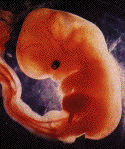 6 weeks – On the 26th day the embryo’s tiny heart begins to beat. The embryo itself is about a 1/4 inch long. Other major organs, including the kidneys and liver, have begun to develop, and the neural tube, which connects the brain and spinal cord, closes. The physical sensations of pregnancy start–nausea, fatigue, sore breasts and frequent urination.
7 weeks – The embryo’s hands and feet are shaped like paddles, but the fingers are beginning to take shape. The embryonic tail has almost disappeared. The pituitary gland is also forming and the fetus is beginning to grow muscle fibers. The heart has divided into the right and left chambers and is beating about 150 beats a minute which is about twice the rate of an adult. The baby’s facial features are visible, including a mouth and tongue. The eyes have a retina and lens. The major muscle system is developed, and the baby starts to practice moving. The baby has its own blood type and the blood cells are produced by the liver now instead of the yolk sac.
8 weeks- The unborn baby is now called a fetus. The fetus is protected by the amniotic sac and filled with fluid. Inside the child swims and moves gracefully. The fetus is now about 3/4 inches long. The arms and legs have lengthened. During this time of development, the baby’s head appears much larger than the body because the brain is growing very rapidly. Brain waves can now be measured. The teeth and the palate are beginning to form and the larynx is developing. Through its parchment-thin skin, the baby’s veins are clearly visible. By the eighth week the ears begin to take shape.
9 weeks – Though the fetus is constantly moving, you won’t be able to actually feel fetal movement for several more weeks. All of the organs, muscles, and nerves are in place and beginning to function. As the hands and feet develop fingers and toes, they lose their paddle-like look, and the touch pads on the fingers form. Make sure you refer to our nutrition section as it is VERY important.
10 weeks – The fetus weighs about 1/3 of an ounce. The heart is almost completely developed and very much resembles that of a newborn baby. An opening the atrium of the heart and the presence of a bypass valve divert much of the blood away from the lungs, as the child’s blood is oxygenated through the placenta. The eyelids have fused shut and won’t open again until week 27. The wrists and ankles have formed and the fingers and toes are clearly visible. Genitals have begun to from, but it is too early to tell the sex of the fetus. By this week of the pregnancy the placenta has developed enough to support most of the critical job of producing hormones .
 11 weeks – The vital organs–the liver, kidneys, intestines, brain and lungs–are fully formed and beginning to function, while the the head is almost half the length of the entire body. The fetus is only about 2 inches long and weighs less than a half ounce but it is busy moving and kicking.
12 weeks – Vocal chords are complete, and the baby can and does sometimes cry silently. The brain is fully formed, and the baby can also feel pain. The fetus may even suck his thumb. The eyelids now cover the eyes, and will remain shut until the seventh month to protect the delicate optical nerve fibers. The hair is on the head and the fingers and toes have developed soft nails. The kidneys are developed and begin to secrete urine.